Mary Ann Glass
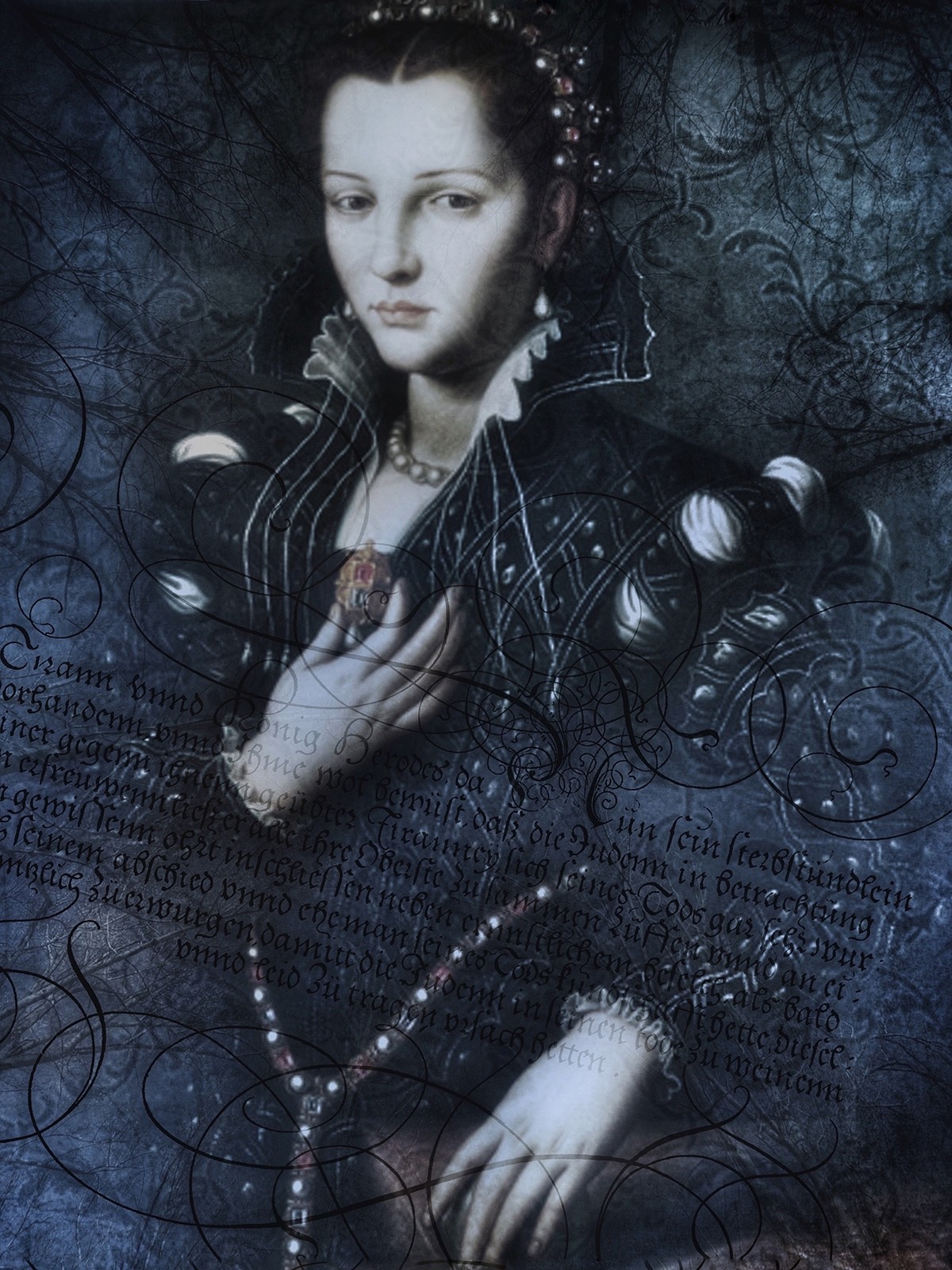
Lucrezia de Medici:
The Last Duchess
Mixed media
16 x 20 inches
More Info:
A pawn of powerful interests. Married off at 13 to consolidate political alignments. Abandoned by her husband for 3 years while he caroused in Paris. And died less than a year after reuniting with her husband, at 16. Less than a year after her arrival at her husband’s court, on 21 April 1561, she died at only 16 years old, after suffering a month of fever, severe weight loss, constant coughing and a permanently bleeding nose. Officially, her death was attributed to “putrid fever”, likely tuberculosis. However, rumors quickly circulated that she had been poisoned, possibly on the orders of her husband. Lucrezia’s death has inspired centuries of fascination. Most notably, the poet Robert Browning immortalized her in the dramatic monologue My Last Duchess, portraying a controlling duke who may have murdered his wife. Lucrezia de’ Medici is remembered as a symbol of the vulnerability of noblewomen, whose lives were often dictated by power, alliance, and silence. My Last Duchess Robert Browning That’s my last Duchess painted on the wall, Looking as if she were alive. I call That piece a wonder, now; Fra Pandolf’s hands Worked busily a day, and there she stands. Will’t please you sit and look at her? I said “Fra Pandolf” by design, for never read Strangers like you that pictured countenance, The depth and passion of its earnest glance, But to myself they turned (since none puts by The curtain I have drawn for you, but I) And seemed as they would ask me, if they durst, How such a glance came there; so, not the first Are you to turn and ask thus. Sir, ’twas not Her husband’s presence only, called that spot Of joy into the Duchess’ cheek; perhaps Fra Pandolf chanced to say, “Her mantle laps Over my lady’s wrist too much,” or “Paint Must never hope to reproduce the faint Half-flush that dies along her throat.” Such stuff Was courtesy, she thought, and cause enough For calling up that spot of joy. She had A heart—how shall I say?— too soon made glad, Too easily impressed; she liked whate’er She looked on, and her looks went everywhere. Sir, ’twas all one! My favour at her breast, The dropping of the daylight in the West, The bough of cherries some officious fool Broke in the orchard for her, the white mule She rode with round the terrace—all and each Would draw from her alike the approving speech, Or blush, at least. She thanked men—good! but thanked Somehow—I know not how—as if she ranked My gift of a nine-hundred-years-old name With anybody’s gift. Who’d stoop to blame This sort of trifling? Even had you skill In speech—which I have not—to make your will Quite clear to such a one, and say, “Just this Or that in you disgusts me; here you miss, Or there exceed the mark”—and if she let Herself be lessoned so, nor plainly set Her wits to yours, forsooth, and made excuse— E’en then would be some stooping; and I choose Never to stoop. Oh, sir, she smiled, no doubt, Whene’er I passed her; but who passed without Much the same smile? This grew; I gave commands; Then all smiles stopped together. There she stands As if alive. Will’t please you rise? We’ll meet The company below, then. I repeat, The Count your master’s known munificence Is ample warrant that no just pretense Of mine for dowry will be disallowed; Though his fair daughter’s self, as I avowed At starting, is my object. Nay, we’ll go Together down, sir. Notice Neptune, though, Taming a sea-horse, thought a rarity, Which Claus of Innsbruck cast in bronze for me!
BIo:
Her work has been described as spiritual and sensual, serious and elegant. She shoots and develops her photographs exclusively with her iPhone.
Mary Ann is from a village in Ohio, attended Ohio State University and the American Graduate School of International Management and moved to Manhattan to pursue not only a career but the dream of big-city sophistication. Eventually, much to her surprise, she built up a career at Chase Manhattan Bank in employee communications. After 13 years there, Mary Ann attended the Rocky Mountain School of Photography in Montana. In 1999, she left her corporate job and settled in the Hudson Valley as a professional photographer.
She is a member of the Women Photographers Collective of the Mid-Hudson Valley and the Rhinebeck Fine Art group and was was one of the founding owners of RiverWinds Gallery in Beacon which featured artists for 17 years. Currently the co-curator of Gallery 40 in Poughkeepsie, she also curates a group of 20 Hudson Valley artists, organizing several IRL popups each year.
Statement:
Using digital apps, I blend many layers into each image to show that underneath the women's surface beauty lies complex stories of joy and trauma and doubt and regret and hope and survival and grief. The underlying images – some of which are apparent, some of which are hidden – are drawn from a diverse file that I keep intuitively adding to: photos of water/trees/skies/fabric/graffiti/walls/outer space/planets/old statues, as well as doodles, mandalas, documents, graphs, old letters, etc etc. And as history major (back in the day), I include with each portrait some information about the woman. The images are mounted on board and the edges are roughly gilded with gold leaf: gold is wealth, success, prestige, achievements. But I made the edges a bit rough: these women took their knocks when they were alive and continue to be critiqued even today.
$220.00